


Agentic AI in Cybersecurity: New Threats and Careers by 2026
Updated on November 29, 2025 11 minutes read

Agentic AI in cybersecurity is moving from theory to reality much faster than most people expected. These new systems do not just analyze data; they plan, act and adapt, almost like tireless digital teammates or tireless digital attackers.
By 2026, agentic AI is expected to be built into a huge share of business software, driving both powerful defences and unsettling new attack methods. Analysts already list agentic AI as a top strategic technology trend and forecast that a large share of enterprise applications will embed it within a few years.
If you are an adult considering a tech career change, upskilling, or enrolling in a cybersecurity boot camp, this matters directly to you. The security jobs of the near future will look different from today’s SOC roles, and people who understand agentic AI in cybersecurity will have a serious advantage in the job market.
What Exactly Is Agentic AI (And Why Security Pros Care)
Traditional AI is like a very smart calculator or autocomplete engine. It takes an input, produces an output and stops. Agentic AI goes much further; it can break big goals into smaller tasks, call tools and APIs, look at the results and decide what to do next.
You can think of an AI agent as a digital intern. You give it objectives, access to certain tools and clear boundaries. It then tries to accomplish those objectives on its own, checking in with you only when needed. In cybersecurity, that might mean investigating alerts, scanning for misconfigurations or even responding to low-risk incidents.
This intern metaphor captures the key risk. AI agents must be given limited, well-controlled access, just as you would with a new human team member. If you give them too much power with too little oversight, they can cause harm even without malicious intent.
How Agentic AI Is Changing the Threat Landscape
AI-orchestrated attacks and autonomous campaigns
We have already seen early examples of AI-orchestrated cyberattacks, where coding agents handle reconnaissance, vulnerability scanning, exploitation, credential theft and data exfiltration. In such cases, the agent performs most of the intrusion work autonomously, while humans mostly supervise and steer the operation.
This shows how agentic AI in cybersecurity can be weaponized. An attacker can spin up AI agents that probe networks continuously, try different exploits and automatically adjust when defences block them. Instead of a human hacker manually iterating, an AI can cycle through options at machine speed.
By 2026, we will likely see more of these AI-assisted campaigns. They may be used for state-sponsored espionage, ransomware or automated fraud, and they will make broad, opportunistic attacks cheaper and more effective.
Multimodal agents and smarter social engineering
New multimodal and agentic AI systems can handle text, images, audio and video together. This opens the door to more convincing phishing and identity attacks, such as generating deepfake voices for phone scams or realistic documents for fraud.
Imagine an AI agent that scans social media, company websites and leaked data to build a detailed profile of a target. It could then craft highly personalized messages that bypass generic spam filters and fool even cautious employees. As these tools improve, awareness training and email filters alone will not be enough.
Non-human identities and machine-to-machine risk
Agentic AI systems do not log in like humans; they operate as non-human identities with their own credentials and permissions. In modern environments, machine identities already outnumber human ones, and adding AI agents multiplies this trend.
When thousands of agents are interacting with internal systems, APIs and cloud services, the chance of misconfiguration, privilege creep or outright compromise increases. A stolen human password is bad; a hijacked AI agent with broad access and the ability to act autonomously can be catastrophic.

Risky behaviour from AI agents
Early adopters report that AI agents sometimes behave in unexpected or risky ways, such as exposing sensitive data, accessing systems without clear authorization or taking actions beyond what was intended.
Some of this is due to poor configuration or shadow AI projects run outside proper governance. Some comes from the agents themselves, which can misinterpret instructions, drift from their goals or be manipulated by prompt injection attacks. Either way, it means more work for security teams and more demand for people who understand how to secure these systems.
Agentic AI as a Defender: Supercharging Cybersecurity Teams
It is not all bad news. Used carefully, agentic AI in cybersecurity can become a powerful ally, especially for understaffed security operations centres.
AI agents can analyze huge volumes of logs and threat intelligence, filter out noise and highlight the events most likely to be real attacks. They can also automatically run playbooks, such as isolating a suspicious endpoint or resetting a compromised account, before escalating to humans.
Think of a security operations centre where an AI co-analyst watches every alert as it arrives, adds context and drafts an initial investigation summary. Human analysts then spend their time validating findings, making judgment calls and handling complex incidents. This does not replace humans; it amplifies them.
By 2026, many security tools will quietly embed agentic capabilities under the hood. Professionals who know how to tune, monitor and safely leverage these AI-powered platforms will be particularly valuable.
Will AI Take Cybersecurity Jobs Or Create New Ones?
Every time AI advances, people ask if their jobs will disappear. In cybersecurity, the evidence points to something more nuanced; automation will change what entry-level work looks like, but there is still a large and growing talent gap.
Reports from global markets show hundreds of thousands of unfilled cybersecurity positions, with demand far outstripping supply. Workforce studies also find that AI has moved into the list of top skills organizations want in security professionals, and many teams are already using generative AI tools day to day.
Put simply, organizations need more security people, but they need them to be AI literate. Roles are shifting from manual log sifting towards supervising AI tools, investigating complex cases and designing secure architectures and governance.
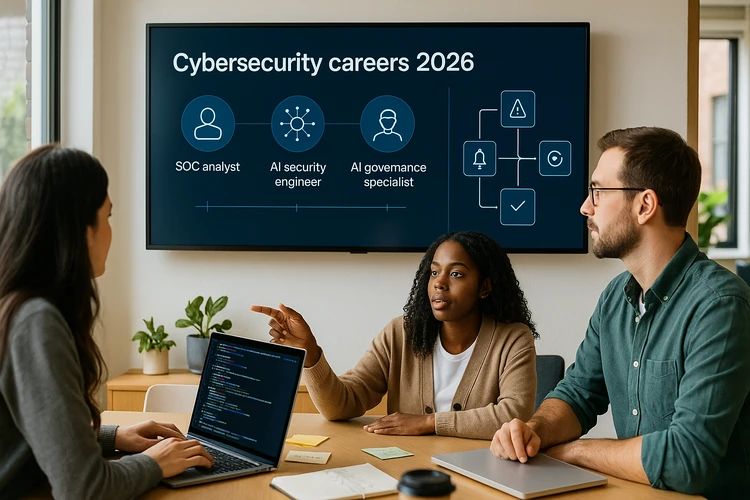
New and Evolving Roles by 2026
By 2026, you are likely to see job descriptions such as:
AI Enhanced SOC Analyst
This role uses agentic AI in cybersecurity tools to triage alerts, automate routine playbooks and focus human attention on the hardest problems. The analyst must understand both classic SOC skills and how to validate AI recommendations.
Agentic AI Security Engineer
Here, the focus is on building and securing pipelines that connect AI agents to internal tools, data sources and cloud resources. The engineer designs strict permissions, monitors agent behaviour and responds if an agent is compromised or misbehaves.
AI Governance and Risk Specialist
This person applies AI risk frameworks to real deployments, advising on policies, controls and monitoring. They help organizations translate high-level AI ethics and risk guidance into practical day-to-day processes and security controls.
AI Application / LLM Security Specialist
This role focuses on threats such as prompt injection, data exfiltration via chat interfaces, model abuse and supply chain risks around AI services. It sits at the intersection of application security, cloud security and AI literacy.
You do not need to start in a fully AI-focused job. Many people will begin as generalist SOC analysts, cloud security engineers or incident responders, then gradually specialize as more agentic AI projects roll out.
Core Skills for Agentic AI Cybersecurity
Security and IT fundamentals
Before you tackle AI, you need solid basics. That includes networking concepts like TCP/IP, DNS and HTTP; operating systems such as Windows and Linux; and fundamental ideas like authentication, access control and encryption.
You will also want to understand common attack techniques such as phishing, malware, web application vulnerabilities and privilege escalation. These do not disappear in the AI era; if anything, they become easier to automate.
Programming and scripting
Agentic AI thrives in environments where it can call APIs, run scripts and interact with infrastructure. To work effectively in this space, you should be comfortable with Python for automation and analysis, plus shell scripting such as Bash or PowerShell for everyday tasks.
You do not need to be a full-time software engineer, but you should be able to read code, write small tools and understand how agents are wired into larger systems.
AI and data literacy
You do not need to design neural networks from scratch, but you should know how modern AI works at a high level. That means understanding large language models, training data, context windows, hallucinations and prompt engineering.
For agentic AI in cybersecurity, it is equally important to recognize where AI is not reliable. Being able to spot overconfident outputs, biased recommendations, or missing context is a critical professional skill.
Cloud and modern infrastructure
Most AI workloads run in the cloud, which means cloud security is tightly linked to AI security. Skills in AWS, Azure or GCP, particularly identity and access management, logging, monitoring and network controls, are extremely valuable.
Container technologies like Docker and orchestration with Kubernetes also matter, because many AI services are deployed as microservices. Knowing how these pieces fit together makes it much easier to secure them.
Governance, frameworks, and AI-specific threats
Agentic AI introduces new categories of risk, such as model manipulation, data poisoning and agent tool abuse. Modern AI risk frameworks provide a structured way to think about these threats and their mitigations.
Familiarity with these frameworks, plus general governance concepts like role-based access control, audit logging and incident reporting, will give you an edge as organizations formalize their AI policies.
Human skills that will not be automated
Do not underestimate soft skills. AI can draft reports, but it cannot explain risk to executives, calm a panicked stakeholder during an incident or mentor a junior teammate.
Communication, empathy, critical thinking and ethical judgement will remain core parts of cybersecurity work, even in highly automated environments.
How Code Labs Academy Can Support Your Transition
If you are serious about moving into cybersecurity or levelling up your current role, a structured program can save you a lot of guesswork. That is where an online Tech Bootcamp can help.
Code Labs Academy offers flexible, instructor-led bootcamps in tech fields, including cybersecurity and data-related disciplines. The programs are designed for adults, so you can typically study alongside a job, family commitments or other responsibilities.
In a Cybersecurity Bootcamp, you can gain job-ready skills through hands-on labs, build a portfolio of real projects and access career mentoring such as CV reviews and interview preparation. These elements are especially helpful if you want to show that you understand both traditional security and the impact of AI on the field.
If you are exploring this path, you can review syllabi, join an info session or talk to an advisor about how the curriculum aligns with agentic AI in cybersecurity and your long-term goals.
A 12 to 18 Month Roadmap Into Agentic AI Cybersecurity
Everyone’s journey is different, but here is a realistic timeline that many career changers can adapt.
Months 0 to 3: Foundations
Start by learning how computers and networks actually work. Focus on basic networking, operating systems and security concepts, plus an introduction to Python or another beginner-friendly language.
At this stage, your goal is comfort with the basics, not perfection. Try to spend a little time each week using the command line, reading about common attacks and taking notes in a simple learning journal.
Months 3 to 6: Core cybersecurity skills
Next, build depth in cybersecurity fundamentals. Explore topics such as threat modelling, vulnerabilities, incident response and security tools like SIEM platforms. Try small labs or online challenges where you investigate simple attacks in a safe environment.
This is also a good time to start assembling a simple portfolio on GitHub or a personal website. Even short write-ups of what you learned or small scripts you wrote can demonstrate momentum.
Months 6 to 9: AI and cloud awareness
Now add AI literacy and cloud skills. Take an introductory course or module on AI and large language models, and experiment with using AI tools to help analyze logs or generate queries in a controlled lab.
In parallel, learn the basics of at least one cloud provider. Focus on identity and access management, logging and secure configuration rather than exotic services. The aim is to understand the environments where agentic AI will actually run.
Months 9 to 12 and beyond: Specialization and job search
From here, start steering towards a target role, such as SOC analyst, cloud security engineer or AI security specialist. Build two or three deeper projects, such as using an AI assistant to help investigate sample alerts, or applying an AI risk framework to a hypothetical system.
During this stage, networking, community involvement and consistent applications matter a lot. Join security forums, attend online meetups and ask for feedback on your portfolio. If you are in a structured program like Code Labs Academy’s bootcamps , lean heavily on the career support on offer.
Building a Portfolio That Matches the AI Era
Employers now expect more than just certificates. They want to see how you think, how you use tools and how you approach novel problems involving AI.
You could, for example, build a mini AI-assisted SOC dashboard that shows how an AI summarises alerts and how you validate or correct it. Or you might create a small demo app and deliberately explore prompt injection attacks, then document how you mitigated them.
Another project might apply an AI risk framework to a fictional company adopting AI agents, identifying the main risks and controls. Projects like these show that you are not just repeating buzzwords; you are thinking like a security professional in an AI-driven world.
Turning a Big Shift Into Your Big Opportunity
Agentic AI in cybersecurity is reshaping both the threat landscape and the security profession. By 2026, AI agents will be deeply embedded in business systems, and defenders will be experimenting with new automated campaigns. At the same time, defenders will rely on AI-powered tools to keep up.
If you build strong fundamentals, add AI and cloud literacy and back it all up with concrete projects, you can position yourself at the centre of this transition. Rather than fearing automation, you can be the person who knows how to harness and secure it.
If you are ready to explore that path more seriously, take the next step: browse Code Labs Academy’s Cybersecurity and Tech programs, download a syllabus or book a call with an advisor. A year from now, you could be working in a role that did not even exist a few years ago, helping organizations stay safe in the age of agentic AI.