


Bootcamp vs Computer Science Degree: What’s Better for Career Switchers?
Updated on October 23, 2025 8 minutes read

You’ve decided to move into tech. Now you’re stuck on the classic fork in the road: bootcamp or computer science degree. Both can change your career. The right choice is the one that gets you job-ready fast, fits your life, and keeps you motivated long enough to cross the finish line.
This guide is written for real people with jobs, families, and limited time. We’ll compare speed, cost, skills, portfolio, and hiring outcomes—without fluff. By the end, you’ll know which path fits your goals and how to make it work.
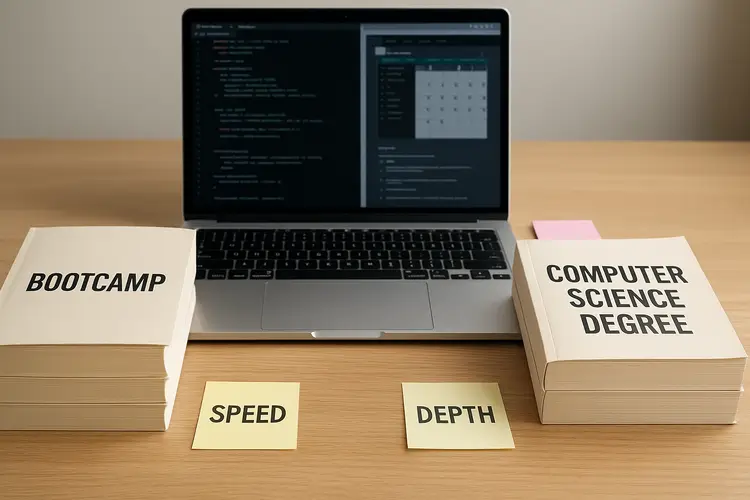
The core trade-off: speed vs. depth
A coding bootcamp is like a well-planned sprint. You learn the modern stack employers use, you build projects that look like real work, and you move from zero to interviews in months. It’s practical, focused, and very measurable.
A computer science degree is endurance training. You learn the theory behind how systems work—algorithms, data structures, operating systems, networks. It’s slower and more expensive, but it unlocks deeper specializations later.
Neither is “better” in general. The question is which trade-off serves your timeline and target role.
Time to value: when do interviews start?
Most career switchers want traction this year, not three years from now. A full-time bootcamp typically runs 12–16 weeks. A part-time bootcamp spreads the load to 6–9 months. You start building your portfolio in week one, and you can begin applying not long after graduation.
A CS degree usually takes 3–4 years. Even if you already hold a degree, a second bachelor’s or a master’s can still run 12–24 months. If your deadline is “I need a junior role within 9–12 months,” a bootcamp aligns better with that clock.
Cost, risk, and the real ROI
Bootcamps are not cheap, but the total cost—tuition plus months out of the workforce—is typically lower than a multi-year degree. Many offer installments or financing. Some regions add scholarships or employer sponsorships.
Degrees can unlock student aid and carry brand recognition, but the opportunity cost is enormous. If you keep working through a part-time bootcamp, you spread risk and maintain income while you build skills. ROI is less about stickers and more about how quickly you hit your first offer.
What actually gets hired in 2025
Hiring managers are shipping features and fixing issues this week. They need people who can jump in, communicate clearly, and move a task across the line.
For Web Development, that means HTML, CSS, JavaScript/TypeScript, React/Next.js, a simple Node API, SQL, Git, and basic deployment. One strong project is a polished full-stack app with auth, clean UI states, and a couple of real workflows.
For Data, it’s Python, SQL, tidy analysis, and a clear story around business questions. A good portfolio shows a notebook with reproducible steps and a small dashboard that answers something specific—no fluff, just insight.
For Cybersecurity, it’s hands-on labs. Show that you can collect logs, detect something suspicious, triage, and document the finding in clear language a teammate can follow.
For UX/UI, it’s research, flows, and systems thinking in Figma. A tight case study that frames the problem, shows your process, and ends with a clickable prototype beats a portfolio of shiny screens with no narrative.
Bootcamps specialize in these applied skills and deliver them fast. Degrees can provide them too, but you often have to assemble the practical parts yourself.
Portfolio vs. GPA: proof beats promises
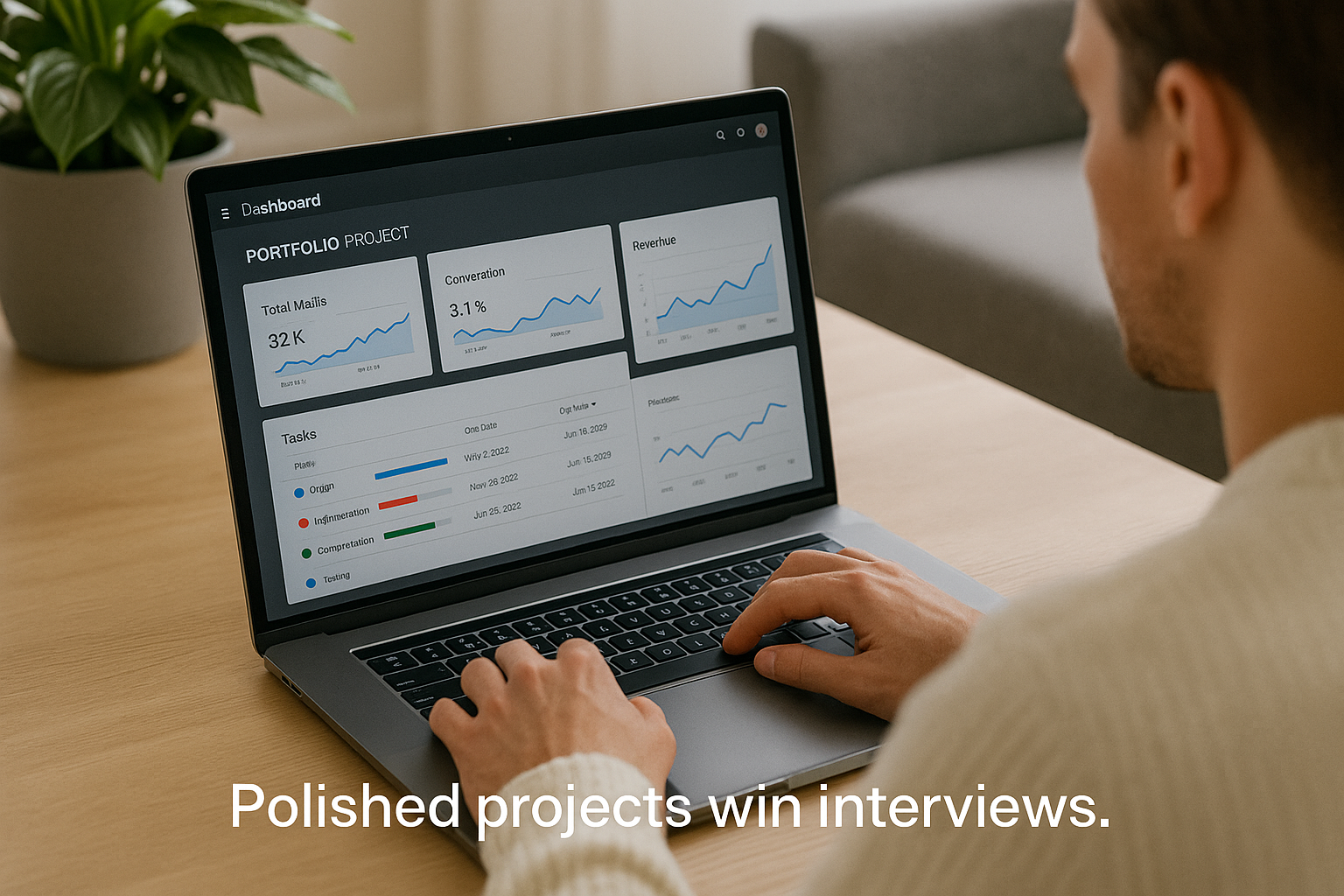
A hiring manager can’t ship your GPA. They will, however, click a live demo and read a README.
Bootcamps push you to produce 2–3 polished pieces that mirror real work: a deployable app, a data analysis with a dashboard, a SOC detection write-up, or a UX case study with research and metrics. These pieces don’t need to be massive. They need to be finished and explained.
Degrees offer transcripts, papers, and exams. Many programs also offer capstones or internships; grab those with both hands. If your degree track doesn’t emphasize applied projects, add them yourself. Your future teammates want proof you can do the work they do.
Career services vs. career center: what helps more?
A good bootcamp treats the job search as a built-in course. You get mock interviews, resume and portfolio reviews, and a plan for outreach and follow-ups. You’ll role-play the hard conversations and learn to talk about trade-offs, not just code.
Universities offer career centers and alumni networks, which can be powerful, but support varies widely. If you take the degree route, push for internships early and seek out clubs, labs, and open-source communities where you can build applied experience before graduation.
The sooner you combine credible projects with interview practice, the sooner recruiters start replying.

How AI changes the picture (and how it doesn’t)
Yes, AI can scaffold tests, draft boilerplate, and suggest patterns. No, it won’t replace your ability to debug, reason, communicate, or work in a team. The juniors who stand out use AI to move faster while keeping fundamentals sharp.
On the bootcamp path, you’ll feel this in day-to-day practice: use AI for grunt work, then take ownership of decisions. On the degree path, you’ll use AI to explore algorithms and read unfamiliar code quickly, but you’ll still have to understand the “why.”
In interviews, be candid: where did AI help, and where did you take the wheel?
Realistic timelines for career switchers
Here’s a pattern that works.
Bootcamp route:
Three to six months of structured learning, then two to four months of focused applications and interviews. Many switchers land offers in 6–10 months when they keep momentum.
Degree route:
One to four years of study depending on program and background, plus internships and a job search. The payoff can be excellent—especially for systems-heavy paths—but the horizon is longer.
Both routes can win. The winner for you is the one you will finish.
A quick scene from each path
Amir, customer support → web dev (bootcamp):
He kept his day job, chose a part-time program, and shipped one feature a week—auth in week three, file uploads in week five, a small admin view in week seven. He documented every release with screenshots and a two-minute Loom. In month five, a hiring manager replied, “We loved the demo and your PR write-ups. Can you talk us through the caching decision?” He could—because he made it.
Lina, biology grad → data analyst (degree + projects):
She enrolled in a one-year master’s, hunted for internships from month one, and joined a lab that ran weekly Python sessions. She built a dashboard for the lab’s experiment tracking, wrote one tight case study, and contributed a small bug fix to an open-source library. When she graduated, her portfolio felt like work, not homework.
Different paths. Same theme: finish projects, tell the story, ask for feedback.
Choosing quickly: a friendly rule of thumb
If your goal is an entry-level role within 12 months, choose bootcamp.
If your goal is deep theory, research, or low-level systems, choose degree.
If you’re constrained by time and money, choose a part-time bootcamp while working.
If you love the academic journey and can invest a few years, the degree will reward your patience—just add applied projects along the way.
Making the bootcamp path work
Keep the scope tight and the cadence steady. Plan three milestones up front:
- Month 1: Foundations and one simple app with a clean README.
- Month 2: Add authentication, a database, or data visualization; refactor for clarity.
- Month 3: Polish, write tests, improve accessibility/performance, and record a two-minute demo.
Add short weekly interview reps: one behavioral story, one debugging drill, one mock question out loud. Post small progress notes. Credibility accumulates.
Making the degree path work
Treat each semester like a mini product cycle. Anchor every theory course with a small applied project: a web app for algorithms, a dashboard for stats, a SOC lab for networks. Apply for internships before you feel ready. Join a lab or open-source repo for code reviews that feel like real life. Your degree gives you depth; your projects show you can ship.
Red flags that slow you down
For bootcamps, beware of vague syllabi, old stack choices, little to no code review, or portfolios that feel like tutorial clones. Ask how often the curriculum updates and how feedback works week to week.
For degrees, beware of programs that leave no room for internships or ignore modern tooling. If your department is heavy on theory but light on practice, you’ll need to push for applied work on the side.
You’re looking for momentum, not magic.
Soft skills that quietly win interviews
Write short, clear PR descriptions. Ask specific questions. Summarize what you tried and what changed. These habits matter more than people realize. Teams hire juniors who learn quickly, communicate simply, and leave things a little better than they found them.
If you’re coming from teaching, support, operations, or design, you already have superpowers: empathy, patience, process thinking. Pair those with new technical skill and you’ll interview well.
Bottom line: which should you pick?
If you want a practical transition into a paid tech role in under a year, a bootcamp is usually the highest-leverage move. If you’re aiming at specialized tracks or research-heavy roles, a degree pays off with depth—just keep shipping applied work alongside it.
Either way, the formula is the same: projects + explanation + practice. Build something real, tell the story simply, and rehearse how you’ll talk through trade-offs. Do that for a few months and you’ll look like someone teams can trust.
Ready to make the switch?
If you want structure, feedback, and career support, our Web, Data, Cybersecurity,
and UX/UI bootcamps help you learn efficiently and prove competence.