


Data Science & AI Bootcamp Syllabus 2026: Python, MLOps, and AI Agents
Updated on December 10, 2025 10 minutes read

If you’re thinking about moving into data science or AI in 2026, the amount of jargon can feel overwhelming. Job posts mention Python, MLOps, LLMs, vector databases and AI agents, but rarely explain what beginners actually need to learn first.
A clear boot camp syllabus turns all that noise into a practical roadmap. Instead of guessing which tools matter, you see a structured path from curiosity to building working data and AI solutions.
Why a 2026 Data Science & AI Syllabus Is Different
Compared with a few years ago, expectations for entry‑level roles have shifted dramatically. It is no longer enough to know a little Python; employers want people who understand how models power real products and decisions.
That is why a 2026‑ready data science and AI program must cover both foundations and modern practices. You should learn how to build a model, deploy it, monitor it, and even integrate it with AI agents and automations.
A strong curriculum prepares you to work across the full lifecycle of data and AI projects. You move from messy raw data to a deployed service or agent that actually solves a business problem for users.
What a Modern Data Science & AI Bootcamp Includes
In a modern Data Science & AI bootcamp, you move through a sequence of connected modules. You start with Python and data analysis, add statistics and SQL, then progress into machine learning and deep learning.
On top of this, the current curriculum introduces MLOps and practical work with large models. That means you learn how to take experiments out of notebooks and turn them into reliable services that others can use.
The experience is tied together by projects and a capstone that mimics real teamwork. When you read any syllabus, you should clearly see this journey from beginner to job‑ready practitioner.
Module 1: Python Foundations for Data Science
Python syntax, mindset and tooling
The first step in any serious program is learning Python basics well. You work with variables, data types, functions, loops and conditionals, and you start to break problems into smaller pieces.
A good syllabus also helps you think like a developer from day one. You practise using virtual environments, managing packages and structuring files so your work scales beyond a single script.
Working with data using NumPy and pandas
Once you are comfortable with syntax, you dive into libraries that power real data work. You use NumPy for numerical operations and pandas for tables, dates and time series, turning messy inputs into clean datasets.
Typical exercises involve loading CSV files, merging tables and handling missing or inconsistent values. By the end of this stage, you should feel confident preparing data for analysis in everyday business scenarios.
Visualising data and telling stories
You then learn how to turn numbers into visual insight with charts and dashboards. Libraries such as Matplotlib or Seaborn help you spot trends, outliers and patterns that are hidden in tables.
A strong syllabus emphasises storytelling as much as raw chart creation. You practise choosing the right visual, highlighting the main message and presenting insights clearly to non‑technical stakeholders.
Module 2: Statistics, SQL and Data Pipelines
Practical statistics for real‑world decisions
To build and evaluate models responsibly, you need a working understanding of statistics. You learn about averages, spread, confidence intervals and distributions, always connected to concrete questions and decisions.
You also explore experiments and A/B tests so you can decide whether a change really helped. This helps you avoid common traps like mistaking correlation for causation when analysing results.
SQL and working with real databases
Most organisations store their information in relational databases rather than flat files. A modern syllabus gives you plenty of practice writing SQL queries that filter, join and aggregate data from several tables.
You then learn how to connect those databases to Python so you can move data in and out of your notebooks. This ability to step between storage and analysis tools is essential for any data professional.
Data pipelines and basic data engineering
As datasets grow larger and more complex, manual steps quickly break down. You study concepts like ETL and ELT and design repeatable data pipelines that can be scheduled and monitored.
Some programs also introduce workflow tools that orchestrate regular jobs and reporting. Even a light exposure to these ideas prepares you to collaborate with data engineers and understand how production systems run.
Module 3: Machine Learning in Practice
Supervised learning: prediction and classification
This is where your work moves from pure analysis to predictive models. You learn to use supervised algorithms for regression when predicting numbers and classification when assigning labels.
Using libraries like scikit‑learn, you experiment with tasks such as churn prediction, demand forecasting or ticket classification. You practise feature engineering, scaling inputs and handling categorical variables so your models behave robustly.
Unsupervised learning and pattern discovery
Not every problem arrives with labelled data attached. Unsupervised learning techniques like clustering and dimensionality reduction help you discover structure and groups in your datasets.
These tools are particularly useful for segmenting customers, understanding behaviour or simplifying complex spaces. They allow you to surface insights even when you are still exploring and defining the question.
Model evaluation and improvement
A key skill in any online bootcamp is learning to judge model quality honestly. You split data into training and validation sets, run cross‑validation and compare metrics such as accuracy, F1‑score or RMSE.
You also explore hyperparameter tuning and ensemble techniques to push performance further. At the same time, you learn to balance complexity against interpretability and long‑term maintainability.
Module 4: Deep Learning and Modern AI
Neural networks and deep learning foundations
Deep learning powers many modern applications, from image recognition to voice assistants. In this module, you study how neural networks are structured, how they learn and where they are most useful.
Working with frameworks such as PyTorch or TensorFlow, you build small projects and watch models improve over time. You learn to monitor training curves, avoid overfitting and choose sensible architectures for your tasks.
Working with images, text or sequences
Different kinds of data call for slightly different modelling strategies. You might build an image classifier, a sentiment analyser or a sequence model for time series forecasting.
Even if you do not specialise immediately, this exposure shows you how deep learning adapts across domains. It becomes easier to pivot later into computer vision, NLP or other specialised fields.
Large language models and embeddings
By 2026, understanding large language models and embeddings will be a core skill. You learn how to call LLMs through APIs or open‑source tools and use them for summarisation, generation and classification.
You also see how embeddings power semantic search, recommendations and retrieval‑augmented generation. This foundation is crucial when you later connect models to tools and design more capable AI systems.
Module 5: MLOps: From Notebook to Production
Software practices and version control
MLOps begins with good software habits rather than fancy infrastructure. You learn version control with Git, work with branches and pull requests, and keep your environments reproducible.
These habits make collaboration much smoother, especially when you join a team or contribute to shared repositories. They also reduce the risk of losing work or shipping code that behaves differently on each machine.
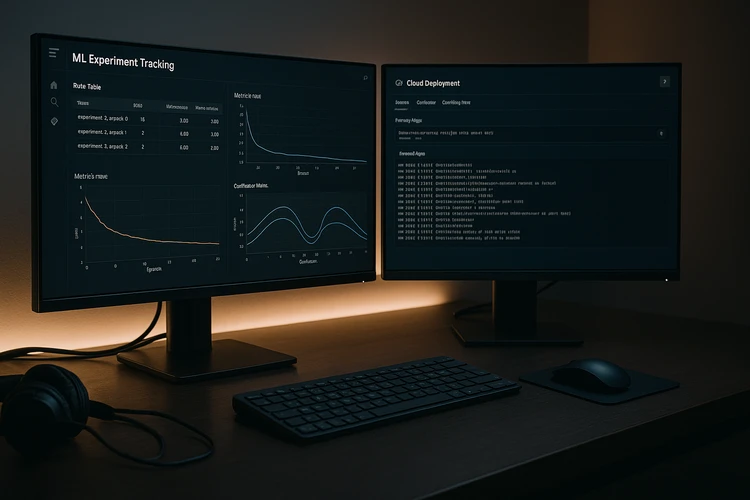
Experiment tracking and model management
In serious projects, you rarely build a single model once and then stop. Instead, you run many experiments and use tracking tools to log metrics, configurations and artefacts.
That history lets you compare approaches fairly and reproduce promising runs later. It also makes it easier to roll back when something fails and to document choices for teammates and stakeholders.
Deployment, monitoring and feedback loops
Deployment is where machine learning meets real users. You learn to wrap models in lightweight APIs, package them in containers and deploy them as services in the cloud.
From there, you focus on monitoring and feedback so models stay healthy over time. You discuss data drift, performance degradation and strategies for retraining or updating models safely.
Module 6: AI Agents and Intelligent Automation
Understanding AI agents
AI agents are systems that can interpret instructions, reason about next steps, and call tools or APIs to act. They go beyond simple chatbots and behave more like small digital colleagues that assist you.
In this part of the sysyllabusyou examine what distinguishes an agent from a plain language model. You explore planning loops, tool calling and different ways for agents to maintain context over multiple steps.
Building and wiring up agents in Python
You then build simple agents yourself using Python and available orchestration tools. For example, you might create an assistant that checks data quality, summarises reports or updates dashboards as an automation.
By combining LLMs with tools, you see how earlier skills in APIs, SQL and modelling all come together. This makes agents a powerful area for portfolio projects that really stand out.
Evaluating and safely operating agents
Because agents can affect external systems, evaluation and safety matter a lot. You design tests, add guardrails and handle tool failures so that agents behave reliably under pressure.
You also learn to log agent behaviour and set scopes for what they are allowed to do. These practices are especially valuable if you want to work on AI products or automation teams.
Portfolio Projects and Capstone Work
For career changers, a strong portfolio often matters more than past job titles. A well‑designed data portfolio shows that you can tackle realistic problems, not just follow tutorials.
Throughout a good program, you complete several guided projects that reinforce individual skills. These include exploratory analysis, modelling exercises and mini dashboards that provide concrete evidence of your progress.
Near the end, you take on one or more capstone projects that span the full lifecycle. You define a problem, gather or select data, build models or agents and present your solution in a polished way.
Many learners host their work on GitHub and share short write‑ups or demos on LinkedIn. This combination of code, communication and problem framing helps hiring managers quickly see your capabilities.

How a Bootcamp Like Code Labs Academy Supports Your Career
A curriculum alone is not enough; how it is delivered matters just as much. Providers such as Code Labs Academy design their bootcamps specifically for adults balancing work, study or family.
First, these programs focus on job‑ready skills rather than abstract theory. You work through realistic scenarios, collaborative exercises and feedback loops that resemble modern data and AI teams.
Second, they help you assemble a portfolio that speaks the language of recruiters. You choose capstone topics that align with common business problems, from churn to forecasting to intelligent assistants.
Finally, Code Labs Academy offers mentoring and career support alongside the technical content. This can include CV and LinkedIn reviews, GitHub feedback, interview practice and guidance on your job search strategy.
Is a Data Science & AI Bootcamp Right for You?
A bootcamp is an intense but focused way to change direction into tech. It suits people who want clear structure, regular accountability and direct support rather than learning everything alone.
You do not need a computer science degree or years of coding experience to join a Code Labs Academy program. You do need curiosity, persistence and the willingness to dedicate consistent time to practice and projects.
If you enjoy solving problems, working with numbers and explaining ideas, data and AI may be a natural next step. The right bootcamp simply accelerates that transition and gives you a framework you would struggle to build alone.
How to Compare Different 2026 Bootcamp Syllabi
When you download syllabi from different schools, look beyond the marketing language on the cover. Ask whether the curriculum really covers Python, statistics, SQL, ML, deep learning, MLOps and AI agents end-to-end.
Check that there are multiple projects, at least one capstone and some form of mentoring or career help. Make sure part‑time or online options fit your schedule, especially if you are working while you study in a bootcamp.
For many learners, a flexible online format such as the one offered by Code Labs Academy makes all the difference. Being able to study from anywhere while keeping your current job can make your career change sustainable.
Conclusion: Turning a Syllabus into a New Career
A strong Data Science syllabus in 2026 is more than a list of topics.
It is a roadmap that takes you from beginner to someone who can analyse data, build models, deploy services and design agents.
By focusing on Python, statistics, SQL, machine learning, deep learning, MLOps and AI agents, you build a future‑proof skill set.
When you add portfolio projects, a capstone and career support, you create a powerful launchpad for a new role.
If this vision matches your goals, your next step is simple.
Explore the Data Science & AI Bootcamp at Code Labs Academy, download the full syllabus and talk to an advisor about your timeline and budget.