


End‑to‑End Secure MLOps for Healthcare: From FHIR Ingestion to Model Serving on Kubernetes
Updated on December 13, 2025 17 minutes read

Healthcare systems collect huge volumes of data: vitals, labs, diagnoses, medications, notes, and imaging. Turning that data into reliable ML systems can improve outcomes, free up staff time, and reduce avoidable readmissions.
At the same time, this data is among the most sensitive information an organization holds. HIPAA’s Security Rule and similar frameworks demand strong technical safeguards, and proposed 2025 updates push harder on encryption, MFA, and formal risk analysis (see high‑level references at the end).
FHIR sits in the middle of this story. It’s the standard used by modern EHRs and health platforms to expose patient data via structured, web‑friendly APIs, exactly what ML pipelines need.
This article is for ML engineers, data scientists, DevOps/MLOps engineers, and technically minded clinicians who want an end‑to‑end view. You already know the basics; you want to see how it fits together securely.
By the end, you’ll be able to:
- Map clinical concepts in FHIR into ML‑ready features.
- Design a secure architecture from FHIR ingestion to model serving on Kubernetes.
- Implement a small Python pipeline for readmission prediction.
- Understand secrets management, CI/CD, and monitoring in a regulated setting.
- Connect each technical choice to concrete clinical and regulatory constraints.
Background and prerequisites
What you should already know
You’ll get the most from this article if you are comfortable with:
- Python scripting and virtual environments
- Basic ML (classification, overfitting, train/validation splits)
- Git, containers, and some Kubernetes vocabulary (pod, deployment, service)
On the domain side, you should at least know what an EHR is, and roughly what counts as a diagnosis, lab, or encounter.
Healthcare data and FHIR essentials
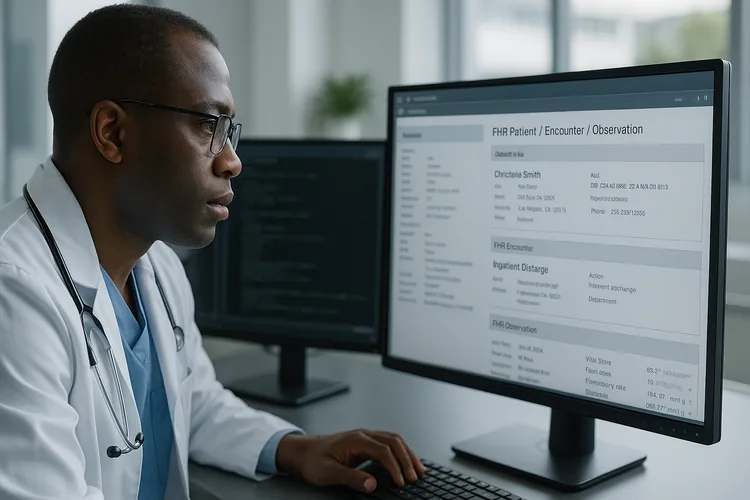
FHIR (Fast Healthcare Interoperability Resources) is an HL7 standard for exchanging healthcare information electronically using common web technologies like REST and JSON.
FHIR breaks health data into resources such as Patient, Encounter, Observation, Condition, and MedicationRequest. Each resource has defined fields and links to others, forming a graph of clinical events rather than flat tables.
In practice, an EHR or cloud platform exposes a FHIR API. Client systems query for resources (e.g., GET /Patient/{id}, GET /Observation?patient=123) and receive JSON documents encoding the patient’s story over time.
FHIR’s structure is excellent for interoperability, but not directly ML‑ready. Your pipeline must aggregate events into patient‑ or encounter‑level feature vectors without losing important clinical nuance.
Security, HIPAA, and why MLOps must care
In the US, the HIPAA Security Rule sets national standards for protecting electronic protected health information (ePHI). It requires covered entities and business associates to implement appropriate administrative, physical, and technical safeguards.
Technical safeguards include access control, audit controls, integrity protections, authentication, and security for data in transit. These are not optional “add‑ons” for healthcare ML; they are requirements.
Proposed 2025 updates emphasize stronger defaults, mandatory encryption, MFA, vulnerability scanning, and detailed data inventories, raising the bar for any ML system that touches ePHI.
MLOps, Kubernetes, KServe, and Vault on one page
MLOps brings software engineering discipline to ML: reproducible training, automated tests, model registries, CI/CD, and monitoring. That discipline is essential when outputs influence clinical care.
Kubernetes is the control plane for workloads. It schedules containers, handles networking, and provides primitives for identity, configuration, and secrets. Many hospitals are standardizing on Kubernetes as their platform of choice.
KServe is an open‑source model serving framework on Kubernetes. It provides the InferenceService CRD for deploying models from multiple frameworks (scikit‑learn, PyTorch, XGBoost, etc.) with autoscaling and canary deployment patterns.
HashiCorp Vault (or similar tools) provides identity‑based secrets management. It stores credentials, tokens, and keys centrally and can sync them into Kubernetes as short‑lived secrets, rather than scattering passwords through YAML and code.
Core theory and intuition: From FHIR events to risk scores
Framing the clinical problem
We’ll anchor our pipeline around a classic healthcare task:
Predict the probability that a patient will be readmitted within 30 days after discharge.
This is clinically meaningful (readmissions are costly and often preventable) and operationally actionable (flag high‑risk patients for extra follow‑up). It’s also simple enough to illustrate ML and MLOps concepts without getting lost in the weeds.
From FHIR resources to feature vectors
For each discharge, we can collect related FHIR resources:
Patient→ demographics (age, sex, maybe region)Encounter→ admission/discharge timestamps, type of stay, length of stayCondition→ chronic and acute diagnoses (e.g., diabetes, heart failure)Observation→ key labs and vitals (e.g., creatinine, hemoglobin, blood pressure)MedicationRequest→ meds at discharge and polypharmacy measures
We then turn this event graph into a numeric feature vector $x \in \mathbb{R}^d$ per encounter. Each component might be:
- a count (number of prior admissions)
- an indicator (has heart failure)
- a summary statistic (max creatinine in last 24 hours)
Logistic regression for readmission risk
A simple but powerful starting model is logistic regression. It estimates the probability of readmission given features $x$:
$$ \hat{y} = \sigma(w^\top x + b) = \frac{1}{1 + e^{-(w^\top x + b)}} $$
Here $w$ is a weight vector, $b$ is a bias term, and $\hat{y}$ is the predicted probability of readmission.
Training minimizes the binary cross‑entropy loss:
$$ L = -\sum_{i=1}^{N}\left[y_i \log(\hat{y}_i) + (1-y_i)\log(1-\hat{y}_i)\right] $$
Because readmissions are often less frequent than non‑readmissions, we typically use class‑weighted loss or resampling so the model pays more attention to mistakes on the positive (readmitted) class.
Why this model fits healthcare constraints
Logistic regression has several advantages in healthcare:
It’s fast and lightweight, so you can run it on CPUs with low latency.
It’s more interpretable than many black‑box methods; coefficients roughly map to risk contributions.
It’s easier to explain to clinicians and auditors, and easier to calibrate to probability outputs.
Of course, gradient‑boosted trees or neural nets may perform better. But in a regulated, safety‑critical environment, extra complexity must pay for itself in accuracy and robustness, not just leaderboard points.
Encoding clinical and policy constraints
The math above assumes we only care about predictive accuracy. In reality, we embed constraints:
Calibration: predicted risks should match observed frequencies, especially at decision thresholds.
Safety rules: never use the model as a hard gate to deny necessary care; treat it as decision support.
Fairness: examine errors and calibration across demographic and clinical subgroups.
These considerations affect thresholding, post‑processing, and how we integrate the model into workflows at the EHR level.
Hands‑on implementation: FHIR → Features → Readmission model

We’ll now build a small end‑to‑end example in Python. It’s not production‑ready, but the structure mirrors what you’d later scale and harden.
The pipeline will:
- Load FHIR‑like bundles from disk
- Extract encounter‑level features into a DataFrame
- Train a logistic regression model using scikit‑learn
- Save the model artifact for later serving
Project layout and configuration
A simple layout might look like this:
healthcare-mlops/
├── data/
│   └── fhir_bundles/
│       ├── bundle_001.json
│       └── ...
├── src/
│   ├── config.py
│   ├── ingest_fhir.py
│   ├── featurize.py
│   └── train_model.py
└── models/
    └── readmission_logreg.joblib
config.py centralizes paths and shows how to keep secrets out of source control:
# src/config.py
import os
from pathlib import Path

BASE_DIR = Path(__file__).resolve().parent.parent

DATA_DIR = BASE_DIR / "data"
FHIR_DIR = DATA_DIR / "fhir_bundles"
OUTPUT_DIR = BASE_DIR / "models"

# In production, this would come from Vault or a cloud secret manager.
DB_URI = os.getenv("TRAINING_DB_URI")  # e.g. "postgresql://user:pass@host:5432/db"
Loading FHIR bundles from disk
We’ll simulate ingestion by reading JSON bundles from a directory. In production, a service would fetch these from an API or data lake, but the structure is the same.
# src/ingest_fhir.py
import json
from pathlib import Path
from typing import Dict, Any, List

from config import FHIR_DIR


def load_fhir_bundle(path: Path) -> Dict[str, Any]:
    "Load a single FHIR Bundle from JSON."""
    with path.open() as f:
        return json.load(f)


def iter_fhir_bundles() -> List[Dict[str, Any]]:
    "Return all bundles in the local directory."""
    bundles = []
    for bundle_path in FHIR_DIR.glob("*.json"):
        bundles.append(load_fhir_bundle(bundle_path))
    return bundles


if __name__ == "__main__":
    bundles = iter_fhir_bundles()
    print(f"Loaded {len(bundles)} bundles")
In a real deployment, you’d also validate each bundle against expected FHIR profiles before using it downstream.
Featurising FHIR into a tabular dataset
Next, we pull demographics, encounter info, diagnoses, and the label from each bundle and build a DataFrame.
# src/featurize.py
from typing import Dict, Any
import pandas as pd

from ingest_fhir import iter_fhir_bundles


def extract_patient(bundle: Dict[str, Any]) -> Dict[str, Any]:
    patient = next(
        e["resource"]
        for e in bundle["entry"]
        if e["resource"]["resourceType"] == "Patient"
    )
    Gender = patient.get("gender")
    # In real data, age would be derived from birthDate.
    age_ext = patient.get("extension", [])
    age = age_ext[0].get("valueInteger") if age_ext else None
    return {"age": age, "gender": gender}


def extract_encounter(bundle: Dict[str, Any]) -> Dict[str, Any]:
    encounter = next(
        e["resource"]
        for e in bundle["entry"]
        if e["resource"]["resourceType"] == "Encounter"
    )
    cls = encounter.get("class", {}).get("code")
    los_ext = encounter.get("extension", [])
    los = los_ext[0].get("valueDecimal") if los_ext else None
    return {"encounter_class": cls, "length_of_stay_days": los}


def extract_conditions(bundle: Dict[str, Any]) -> Dict[str, Any]:
    codes = []
    for e in bundle["entry"]:
        res = e["resource"]
        if res["resourceType"] == "Condition":
            for c in res.get("code", {}).get("coding", []):
                code = c.get("code")
                If code:
                    codes.append(code)

    has_diabetes = any(code.startswith(("E10", "E11")) for code in codes)
    has_chf = any(code.startswith("I50") for code in codes)
    return {"has_diabetes": int(has_diabetes), "has_chf": int(has_chf)}


def extract_label(bundle: Dict[str, Any]) -> int:
    encounter = next(
        e["resource"]
        for e in bundle["entry"]
        if e["resource"]["resourceType"] == "Encounter"
    )
    for ext in encounter.get("extension", []):
        if ext.get("url", "").endswith("readmittedWithin30Days"):
            return int(ext.get("valueBoolean"))
    raise ValueError("Missing readmission label")


def build_dataset() -> pd.DataFrame:
    rows = []
    for bundle in iter_fhir_bundles():
        row = {}
        row.update(extract_patient(bundle))
        row.update(extract_encounter(bundle))
        row.update(extract_conditions(bundle))
        row["readmitted_30d"] = extract_label(bundle)
        rows.append(row)

    Df = pd.DataFrame(rows)
    df = pd.get_dummies(df, columns=["encounter_class", "gender"], dummy_na=True)
    return df


if __name__ == "__main__":
    df = build_dataset()
    print(df.head())
This is deliberately simplified, but the pattern is realistic: extract, aggregate, and encode FHIR resources into a consistent internal schema.
Training and evaluating the model
Now we train a logistic regression model on our tabular dataset and evaluate it.
# src/train_model.py
from pathlib import Path

Import joblib
from sklearn.linear_model import LogisticRegression
from sklearn.metrics import roc_auc_score, f1_score, classification_report
from sklearn.model_selection import train_test_split

from featurize import build_dataset
from config import OUTPUT_DIR


def train_readmission_model() -> Path:
    df = build_dataset()

    target = "readmitted_30d"
    X = df.drop(columns=[target])
    y = df[target]

    X_train, X_test, y_train, y_test = train_test_split(
        X, y, test_size=0.2, random_state=42, stratify=y
    )

    model = LogisticRegression(
        max_iter=1000,
        class_weight="balanced",
        solver="liblinear",
    )
    model.fit(X_train, y_train)

    y_proba = model.predict_proba(X_test)[:, 1]
    y_pred = (y_proba >= 0.5).astype(int)

    auc = roc_auc_score(y_test, y_proba)
    f1 = f1_score(y_test, y_pred)

    print(f"ROC-AUC: {auc:.3f}")
    print(f"F1-score: {f1:.3f}")
    print(classification_report(y_test, y_pred))

    OUTPUT_DIR.mkdir(parents=True, exist_ok=True)
    model_path = OUTPUT_DIR / "readmission_logreg.joblib"
    joblib.dump({"model": model, "feature_columns": X.columns.tolist()}, model_path)
    print(f"Saved model to {model_path}")
    return model_path


if __name__ == "__main__":
    train_readmission_model()
We focus on domain‑appropriate metrics:
- ROC‑AUC for ranking patients by risk
- F1 for class imbalance when you care about both recall and precision
- A full classification report to see per‑class behavior quickly
The saved artifact (readmission_logreg.joblib) is what we’ll later load into a serving stack on Kubernetes.
Systems and operations: Secure data flow on Kubernetes
An end‑to‑end reference architecture
Here’s a pragmatic, cloud‑agnostic architecture from FHIR ingestion to Kubernetes serving:
Secure network and identity Workloads run in private subnets; access is via VPN or peered VPCs. Services authenticate using OIDC or service accounts, not shared passwords.
FHIR ingestion layer
A fhir-ingestor service calls the FHIR API using TLS and OAuth2 client credentials with minimal scopes. It validates bundles, pseudonymizes identifiers, and writes them to encrypted object storage or a Kafka topic.
Curated analytics/feature layer Airflow or Argo Workflows jobs read raw bundles and build encounter‑level tables. Outputs are stored in a warehouse with row‑ and column‑level security policies.
Training and registry Training jobs run as containers on Kubernetes, orchestrated by Argo Workflows or Kubeflow Pipelines. MLflow (or similar) tracks models, metrics, and lineage.
Model serving
Models are deployed via KServe InferenceService resources, pulling artifacts from object storage.
Clinical applications EHR add‑ons or SMART on FHIR apps call internal APIs that, in turn, call the KServe endpoint and display risk scores with explanations.
Secure FHIR ingestion patterns
For production ingestion, follow a few key patterns:
- Always use TLS for transport; prefer mutual TLS between ingestion services and your FHIR gateway.
- Use OAuth2 / SMART-on-FHIR scopes so services can only access required resources.
- Apply pseudonymization early: replace MRNs or national IDs with internal keys; keep the mapping in a separate, heavily protected service.
- Encrypt data at rest (object storage, databases) using KMS‑managed keys.
You can do this in batch (scheduled exports) or near‑real time (event‑driven ingestion triggered by new encounters and observations).
Secrets management with Vault and operators
Instead of embedding secrets into Kubernetes manifests, use a secrets manager like HashiCorp Vault:
Vault stores FHIR client secrets, DB passwords, and TLS keys with identity‑based access control.
A Vault Secrets Operator (or Vault Agent injection) syncs them into Kubernetes Secrets or injects them directly as files/env vars.
A simplified deployment leveraging Vault annotations might look like:
apiVersion: apps/v1
kind: DeploymentMetadata:
  name: training-job-runner
Spec:
  replicas: 1
  Selector:
    matchLabels:
      app: training-job-runner
  Template:
    Metadata:
      Labels:
        app: training-job-runner
      Annotations:
        vault.hashicorp.com/agent-inject: "true"
        vault.hashicorp.com/role: "ml-training"
        vault.hashicorp.com/agent-inject-secret-db-creds: "secret/data/ml/db."
   Specc:
      Containers:
        - name: trainer
          image: registry.example.com/healthcare-mlops/train:latest
          env:
            - name: DB_URI
              valueFrom:
                secretKeyRef:
                  name: db-creds
                  key: uri
Secrets can then be rotated centrally without touching container images or manifests, an operational and security win.
CI/CD and GitOps for ML services
For both infrastructure and models, Git should be the source of truth:
Keep Kubernetes manifests, Helm charts, and KServe definitions in a repo.
Keep ML pipelines and configuration in another; reference model versions explicitly.
Tools like Argo CD implement GitOps: they compare live cluster state to Git and sync changes automatically or on approval.
A typical pipeline might:
- Run unit tests, data contract tests, and static analysis on every commit.
- Train/retrain the model on specific branches or tags.
- Compute performance + fairness metrics against baselines.
- If thresholds are satisfied and approvals obtained, update an
InferenceServicemanifest. - Let Argo CD sync that manifest to staging and then production.
Example KServe InferenceService for our readmission model
apiVersion: serving.kserve.io/v1beta1
kind: InferenceService
metadata:
  name: readmission-risk-v1
Spec:
  Predictor:
    sklearn:
      storageUri: "s3://ml-models/readmission/v1/"
      Resources:
        Requests:
          cpu: "500m"
          memory: "1Gi"
        Limits:
          cpu: "1"
          memory: "2Gi"
Template this with Helm or Kustomize and parameterize environments, resource limits, and model versions.
Observability, performance, and cost
In production, treat the model endpoint like any other critical service:
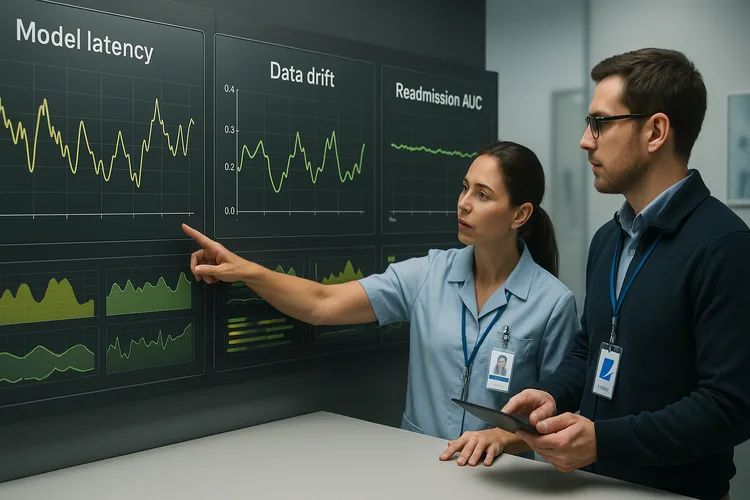
Collect metrics for latency, QPS, and error rates via Prometheus; visualize with Grafana.
Monitor input feature distributions to detect drift and trigger investigations.
Log predictions and (eventually) outcomes in a controlled way for post‑deployment analysis.
Most tabular healthcare models run comfortably on CPUs. Use autoscaling and “scale to zero” if cold‑start latency is acceptable for the workflow.
Risk, ethics, safety, and governance
Privacy and technical safeguards
The HIPAA Security Rule requires reasonable administrative, physical, and technical safeguards to ensure the confidentiality, integrity, and availability of ePHI.
For ML pipelines, that translates into:
- Data minimization: ingest only what you need; avoid free‑text unless necessary.
- De‑identification/pseudonymization: especially in dev/test.
- Access control: strict RBAC in Kubernetes; fine‑grained permissions in warehouses.
- Encryption everywhere: in transit (TLS) and at rest (disks, object stores, databases).
Proposed 2025 changes emphasize mandatory MFA, structured risk analysis, and stronger vendor oversight—meaning your MLOps stack will be scrutinized not just for functionality but for security posture.
Bias, fairness, and clinical impact
Healthcare data reflects historical patterns of access, coding, and treatment. If you train models naively, they can perpetuate or amplify inequities.
You should:
Evaluate performance and calibration across demographic subgroups (e.g., age, sex, socioeconomic proxies).
Decide how thresholds should be set (and whether they should differ), with ethics + clinical oversight.
Design workflows where the model proposes, and humans dispose: clinicians review and confirm/override suggestions.
Poorly governed models risk over‑ or under‑treating specific groups, which is ethically problematic and reputationally damaging.
Robustness, drift, and failure modes
ML systems in healthcare can fail in multiple ways:
Data drift: lab ranges or coding practices change, breaking assumptions.
Concept drift: new treatments/policies change relationships between features and outcomes.
Infrastructure failures: FHIR server downtime or misconfigured NetworkPolicies.
Mitigations include:
- Regular drift monitoring and retraining schedules.
- Canary or shadow deployments for new models. Clear fallbacks: if the ML service is unavailable, revert to simpler rules or clearly indicate the score is not available.
This isn’t just engineering hygiene; it prevents silent degradation in clinical decision support.
Governance and documentation
In a hospital or health system, governance artifacts matter:
- Model cards describing purpose, data sources, populations, limitations, and caveats.
- Data flow diagrams showing where ePHI flows, rests, and who can access it.
- Risk assessments aligned to organizational cybersecurity frameworks and regulatory expectations.
These documents help auditors and clinicians understand and trust the system, and they make future maintenance much easier.

Case study: Readmission risk in a hospital network
Problem and goals
Imagine a hospital network that wants to reduce 30‑day readmissions on medical wards. They want to identify high‑risk patients before discharge and target them for extra support: follow‑up calls, earlier appointments, home health visits.
Aims:
- Improve patient outcomes and experience.
- Reduce penalties associated with readmission metrics.
- Do this in a way that is fair, explainable, and secure.
Data sources and ingestion
Data comes from the hospital’s FHIR servers:
Encounterresources for admissions and dischargesPatientfor demographicsConditionfor chronic illnesses and acute diagnosesObservationfor labs and vitals during the stay
A fhir-ingestor microservice pulls recent discharges nightly, validates bundles, pseudonymizes IDs, and drops them into encrypted storage. ETL jobs build an encounter‑level training dataset with labels derived from subsequent encounters within 30 days.
Modeling and evaluation
Data scientists train several models:
Baseline logistic regression with features like age, comorbidity flags, lab summaries, and length of stay.
Gradient boosted trees for comparison, with careful feature importance analysis
They evaluate:
AUC, F1, and calibration curves overall
Performance and calibration by age group, sex, and major disease categories
Only models that meet predefined performance and fairness thresholds and pass clinical review are candidates for deployment.
Deployment on Kubernetes with KServe
Once approved:
The model is logged in the registry and exported to S3‑compatible storage with versioned paths.
A pull request updates the readmission-risk-v1 InferenceService to point to the new artifact.
CI validates manifests and ensures the artifact exists and passes smoke tests. After approvals, Argo CD syncs the new InferenceService into production.
At runtime:
A discharge planning app calls an internal API, which fetches features, calls the KServe endpoint, and returns a risk score plus explanation.
If the score exceeds a configured threshold, the patient appears in a prioritized worklist for a care coordinator. Requests and decisions are logged in an auditable way; performance is recomputed using real‑world outcomes.
Skills mapping and learning path
Technical skills you build
Programming and data
Parsing nested JSON (FHIR bundles) into structured features. Writing modular, testable Python for data pipelines. Using pandas and scikit‑learn for tabular ML
ML and evaluation
Training and tuning logistic regression and tree‑based models. Handling class imbalance with weighting and appropriate metrics. Evaluating calibration and subgroup performance
MLOps and infrastructure
Containerizing with Docker, Writing Kubernetes manifests, and understanding services, deployments, and secrets, deploying models with KServe, and managing rollouts
Security and governance
Using environment variables and Vault/KMS for secrets. Understanding HIPAA technical safeguards practically. Designing systems with audits, documentation, and risk assessments
Domain skills you develop
Reading and interpreting FHIR resources as real clinical concepts. Understanding readmission as a quality metric and how risk scores fit into discharge workflows, communicating model behavior and limitations to clinicians and stakeholders
Suggested learning path
Step-1: Prototype the ML pipeline
Build the Python pipeline in Hands‑on implementation using synthetic FHIR data and experiment with feature sets.
Step-2: Add tests and CI
Introduce unit tests, data validation, and basic CI checks.
Step-3: Containerize and run locally
Package training and inference into containers; run on a local Kubernetes cluster (kind or Minikube).
Step-4: Introduce KServe and GitOps
Deploy your model as a KServe service, for Example, KServe’s InferenceService, and manage manifests with Git + Argo CD.
Step-5: Harden security and add monitoring
Wire in Vault Secrets management, define NetworkPolicies, and add metrics + drift monitoring Observability.
Each step can be a standalone portfolio project and prepares you for real MLOps roles in healthcare (and other regulated domains).
FHIR provides the structure you need to build ML from EHR data, but you must design robust feature pipelines to tame its complexity. If your features are brittle, everything downstream, training, evaluation, and serving becomes unreliable.
Security and compliance are fundamental, not an optional extra, when your pipeline touches ePHI and clinical workflows.
Treat identity, access control, encryption, and audit trails as first-class design requirements.
Kubernetes, KServe, and GitOps let you run multiple models reliably at scale with clear control over deployments and rollbacks. That operational discipline is what makes ML usable in real clinical systems, not just in notebooks.
Simple, interpretable models plus strong engineering often beat more complex approaches in safety‑critical settings.
In healthcare, “better” usually means calibrated, explainable, monitored, and resilient, not just a higher AUC.
Interdisciplinary skills, ML, cloud, security, and clinical understanding are what make healthcare MLOps both challenging and rewarding. That mix is also what makes you valuable on teams building regulated, real‑world AI.
Next Steps
If you want to take this further, pick a single use case (like readmission risk), implement the pipeline, and iterate, adding one production capability at a time.
This keeps the scope realistic while still moving you toward a deployable, auditable system.
Start by implementing the baseline feature + model pipeline in the Hands‑on implementation. Then design your secure runtime architecture in Systems and Operations. Add Vault‑backed secrets handling in Secrets management. Ship safely with CI/CD and GitOps. Make it dependable with Observability and Drift/failure mode planning.
Want feedback, structure, and a clear learning path while you build? For the ML + data foundation behind secure MLOps, start here: Data Science & AI Bootcamp
To strengthen the security layer (threat modeling, secure practice, operational thinking), start here: Cyber Security Bootcamp
To ship reliable services around models (APIs, integration, deployment fundamentals), start here: Web Development Bootcamp
If you’d like a human to help you choose the right track, schedule a call: