


Designing HIPAA‑Conscious RAG Pipelines for Clinical Notes with Python and Open‑Source LLMs
Updated on December 12, 2025 18 minutes read

Clinical notes capture the messy, real story of patient care: impressions, doubts, social context, and evolving plans.
They are also saturated with protected health information (PHI) and tightly regulated by frameworks like HIPAA in the US, making them hard to use safely at scale.
At the same time, clinicians and informatics teams want retrieval‑augmented generation (RAG) systems that can read charts and answer questions. Think of queries like “Has this patient ever had angioedema on ACE inhibitors?” or “How has their kidney function changed over the last three admissions?”
The challenge is to get the benefits of RAG and LLMs without leaking PHI to external services. This article will show you how to design a pipeline that keeps raw PHI inside your security boundary while still enabling powerful clinical querying and summarisation.
Background and Prerequisites
Who this article is for
This guide targets engineers, data scientists, and advanced learners who already know basic Python and ML concepts.
If you understand embeddings, cosine similarity, and REST APIs, you’re in the right place.
You don’t need to be a doctor, but some familiarity with electronic health records (EHRs) and clinical note structure helps.
We’ll keep the medical parts grounded and explain jargon as we go.
Minimal technical background
You should be comfortable with:
- Python scripting and virtual environments.
- Fundamental ML ideas: training vs inference, overfitting, vector representations.
- Basic NLP: tokenization, sentence embeddings, Transformer‑style models.
If you’re new to RAG, you mainly need to grasp the idea of combining retrieval (find relevant text) with generation (LLM writes an answer). The math we use will be light and intuitive.
HIPAA, PHI, and clinical text in a nutshell
Under HIPAA, PHI is health information that can be tied to an individual, covering both clinical details and identifiers like name, address, and dates.
The Privacy Rule describes a set of common identifiers (often summarised as “18 identifiers”) that must be removed or transformed for data to count as de‑identified.
HIPAA recognises two main ways to de‑identify data:
Safe Harbor: remove all listed identifiers (name, detailed geography, dates except year, contact numbers, record IDs, etc.) and have no actual knowledge that the remaining data can identify a person.
Expert Determination: A qualified expert uses statistical methods to show that re‑identification risk is very small in the intended context.
Once properly de‑identified, data is no longer PHI under HIPAA, which gives you more freedom to process and share it. But getting to that point, especially with free‑text clinical notes, is non‑trivial.
Clinical notes are messy, dense, and idiosyncratic. PHI can appear in headers, free text, templated blocks, and even in lab or imaging sections pasted into notes.
RAG and open‑source LLMs for clinical work
Retrieval‑augmented generation (RAG) combines a search component and a generator.
First, you retrieve relevant note snippets; then, an LLM uses them as grounded context to produce an answer or summary.
In healthcare, RAG has clear advantages:
- It reduces hallucination by grounding answers in actual notes and guidelines.
- It lets smaller, local models punch above their weight by giving them the right context.
- It creates a natural audit trail: “this answer came from these specific note chunks.”
We now have several open‑weight medical LLMs that you can host yourself:
- Meditron‑7B / 70B: tuned for medical tasks using LLaMA‑2 as a base and continued pre‑training on clinical literature and guidelines.
- BioGPT: a Transformer language model trained on PubMed abstracts.
- Other open models evaluated on clinical note tasks, including social determinants of health extraction.
Running these locally (on‑prem or in a HIPAA‑eligible VPC) is central to building a RAG pipeline that never sends raw PHI to external services.
Intuition: What Makes a RAG Pipeline “HIPAA‑Conscious”?
The basic RAG loop for clinical notes
In a standard RAG pipeline, you can think of three stages: encoding, retrieval, and generation.
We’ll write them in simple notation so you can formalise the mental model.
-
You ingest notes $d_1, \dots, d_N$ from the EHR.
Each note is split into chunks $c_i$ (for example, 256–512 tokens). -
Each chunk becomes an embedding vector:
$e_i = f_{\text{embed}}(c_i) \in \mathbb{R}^k$
Here $f_{\text{embed}}$ is your encoder (e.g., a SentenceTransformer).
-
At query time, you embed the query $q$:
$e_q = f_{\text{embed}}(q)$
-
You compute similarity between the query and chunks, commonly using cosine similarity:
$$s(q, c_i) = \cos(e_q, e_i) = \frac{e_q \cdot e_i}{|e_q| , |e_i|}$$ -
You select the top‑$K$ chunks by similarity and pass them, plus the query, to an LLM:
$$ y = f_{\text{LLM}}\big(q, c_{(1)}, \dots, c_{(K)}\big) $$ Where (y) is the generated answer or summary.
The magic is in what you choose for $f_{\text{embed}}$, how you define your index, and what guardrails you put around $f_{\text{LLM}}$.
Where PHI can leak in this pipeline
Every step where text or embeddings move between systems is a potential leak point. A recent survey of privacy issues in healthcare LLM pipelines highlights risks in storage, transmission, retrieval, and generation.
Main risk zones:
-
Ingestion and storage
Raw notes with PHI land in data lakes, cache layers, and log files. If logging is careless, you can end up with PHI sprayed across monitoring tools. -
Embedding and indexing
If you use a SaaS embedding API, raw text is sent to an external provider. Even embeddings stored alongside patient IDs might allow partial re‑identification in some settings. -
Retrieval and access control
Naïve similarity search can pull chunks from the wrong patient if you don’t filter by patient/encounter. Misconfigured access control can let staff see notes for patients they shouldn’t access. -
Generation and external LLMs
If you call a hosted LLM with raw note context, that’s clearly PHI leaving your boundary. Even with de‑identification, there is residual risk if the context is rich and specific enough.
A HIPAA‑conscious RAG design tries to minimise the number of components that ever see PHI.
It also defines a clear “PHI boundary” and ensures nothing crosses that line without strong justification.
A simple risk model for PHI leakage
You can model PHI leakage risk as:
$Text{Risk} \approx P(\text{PHI leaves boundary}) \times \text{Impact of leakage}$
You reduce risk in two ways:
- Drive $P(\text{PHI leaves boundary})$ as close to zero as possible through design.
- Reduce impact via least‑privilege access, encryption, logging, and incident response plans.
In practice, this means:
- Host embedding models and LLMs inside your PHI boundary.
- If you must use external services, send only data that has been robustly de‑identified and sign proper agreements.
Hands‑On: Building a HIPAA‑Conscious RAG Pipeline in Python

We’ll now build a small but realistic RAG prototype with Python. The goal is to illustrate design patterns, not to provide production‑ready de‑identification.
Our toy pipeline will:
- Represent synthetic clinical notes with PHI.
- Chunk and embed notes using a local embedding model.
- Store embeddings in FAISS for similarity search.
- Perform patient‑scoped retrieval.
- Call a local LLM server that never sends data off the box.
Step 1 – Environment setup
We’ll use standard Python libraries:
pydanticfor data models.sentence-transformersfor embeddings.faiss-cpufor vector search.requestsfor HTTP calls to the local LLM.
Install dependencies:
pip install "pandas>=2.0" \
            "transformers>=4.46" \
            "sentence-transformers>=3.0" \
            "faiss-cpu" \
            "pydantic>=2.0"
For the LLM, imagine you’ve deployed a model like Meditron‑7B or Mistral‑7B behind a local HTTP endpoint using vllm, text-generation-inference, or ollama.
We’ll treat it as a black‑box endpoint called http://localhost:8000/generate.
Step 2 – Modeling clinical notes and the PHI boundary
We start by representing notes as Pydantic models.
The important idea is that patient_id and raw text remain inside a secure environment.
from pydantic import BaseModel
from datetime import datetime
from typing import List

class ClinicalNote(BaseModel):
    note_id: str
    patient_id: str          # PHI, never leaves the boundary
    encounter_id: str
    author_role: str
    created_at: datetime
    raw_text: str            # contains PHI
For the tutorial, we’ll fabricate two simple notes.
In real life, you’d pull these from an EHR via an ETL or FHIR interface.
sample_notes: List[ClinicalNote] = [
    ClinicalNote(
        note_id="N1",
        patient_id="P12345",
        encounter_id="E1",
        author_role="hospitalist",
        created_at=datetime(2025, 11, 1, 9, 30),
        raw_text=(
            "John Smith (DOB 03/14/1965) admitted 11/01/2025 with dyspnea. "
            "Lives at 123 Main St, Springfield. PMH: HTN, T2DM. On lisinopril, metformin. "
            "No known drug allergies. Wife, Mary, reachable at 555-123-4567. "
            "Plan: start IV furosemide, monitor sats, transthoracic echo."
        ),
    ),
    ClinicalNote(
        note_id="N2",
        patient_id="P12345",
        encounter_id="E1",
        author_role="cardiology",
        created_at=datetime(2025, 11, 2, 14, 15),
        raw_text=(
            "Cardiology consult for John Smith. Suspect HFpEF. BNP elevated. "
            "Echo: preserved EF, diastolic dysfunction. Recommend continuing diuresis."
            "Optimize BP control, outpatient sleep study. Patient works as a bus driver."
        ),
    ),
]
Step 3 – A lightweight PHI masker for external flows
Inside your PHI boundary, you usually keep identifiers so you can link data and audit access. The key rule is that raw PHI must not cross into non‑HIPAA‑grade systems.
We’ll define a toy PHI masker using regex. This is absolutely not sufficient for production, but the pattern is instructive.
import re

PHI_PATTERNS = [
    # Extremely naive patterns for illustration only
    (re.compile(r"\b(John Smith|Mary)\b", re.IGNORECASE), "[NAME]"),
    (re.compile(r"\b\d{2}/\d{2}/\d{2,4}\b"), "[DATE]"),
    (re.compile(r"\b\d{3}-\d{3}-\d{4}\b"), "[PHONE]"),
    (re.compile(r"\b\d{1,5}\s+[A-Za-z]+\s+(St|Street|Ave|Avenue|Rd|Road)\b"), "[ADDRESS]"),
]

def mask_phi(text: str) -> str:
    "Tutorial-only PHI masker. Do NOT use as-is in production."""
    masked = text
    For pattern, replacement in PHI_PATTERNS:
        Masked = pattern.sub(replacement, masked)
    return masked
You would apply mask_phi only when text must leave your boundary. For internal use with a local LLM, you generally keep the original text and rely on access control and logging.
In a real project, you’d use specialised de‑identification models evaluated on clinical corpora, ideally as part of a HIPAA Expert Determination process.
Step 4 – Chunking and embedding notes locally
Next, we chunk each note into smaller passages and embed them with a local encoder. Chunking by characters is crude but fine for a demonstration.
from sentence_transformers import SentenceTransformer
import numpy as np
import textwrap

EMBEDDING_MODEL_NAME = "sentence-transformers/all-MiniLM-L6-v2"
embedding_model = SentenceTransformer(EMBEDDING_MODEL_NAME)

def chunk_text(text: str, max_chars: int = 400) -> List[str]:
    "Split text into fixed-length character chunks."""
    text = text.strip()
    return textwrap.wrap(text, max_chars)
We now define a NoteChunk data model, including the embedding vector. These embeddings stay inside secure memory or encrypted storage.
class NoteChunk(BaseModel):
    chunk_id: str
    note_id: str
    patient_id: str
    encounter_id: str
    text: str              # may contain PHI
    embedding: np.ndarray
And we create chunks and embeddings:
note_chunks: List[NoteChunk] = []

For note in sample_notes:
    chunks = chunk_text(note.raw_text, max_chars=300)
    for i, chunk_text_ in enumerate(chunks):
        embedding = embedding_model.encode(chunk_text_, convert_to_numpy=True)
        note_chunks.append(
            NoteChunk(
                chunk_id=f"{note.note_id}_c{i}",
                note_id=note.note_id,
                patient_id=note.patient_id,
                encounter_id=note.encounter_id,
                text=chunk_text_,
                embedding=embedding,
            )
        )

print(f"Created {len(note_chunks)} chunks.")
At this point, you have a list of PHI‑containing chunks and their embeddings. Nothing has left your PHI boundary, and you haven’t touched any external APIs.
Step 5 – Building a FAISS similarity index
To support fast retrieval, we build an FAISS index over the embeddings.
We’ll use inner‑product search with L2‑normalised vectors to approximate cosine similarity.
import faiss

embedding_dim = note_chunks[0].embedding.shape[0]
emb_matrix = np.vstack([c.embedding for c in note_chunks]).astype("float32")

index = faiss.IndexFlatIP(embedding_dim)
faiss.normalize_L2(emb_matrix)
index.add(emb_matrix)

chunk_metadata = note_chunks   # same order as emb_matrix
print("Index size:", index.ntotal)
In a real system, this index might be a dedicated service backed by FAISS, Qdrant, or pgvector. The same pattern holds: embeddings and metadata stay on encrypted storage inside your PHI boundary.
Step 6 – Patient‑scoped retrieval to avoid cross‑patient leaks
In clinical workflows, queries are almost always scoped to a specific patient. We can enforce that any retrieved chunk must share the patient ID with the current context.
from typing import Tuple

def retrieve_chunks_for_patient(
    query: str,
    patient_id: str,
    top_k: int = 5,
) -> List[Tuple[NoteChunk, float]]:
    """Retrieve top_k chunks for a given patient, with similarity scores."""
    q_emb = embedding_model.encode(query, convert_to_numpy=True).astype("float32")
    q_emb = q_emb / np.linalg.norm(q_emb, ord=2)

    D, I = index.search(q_emb.reshape(1, -1), top_k * 5)
    results: List[Tuple[NoteChunk, float]] = []

    for idx, score in zip(I[0], D[0]):
        if idx == -1:
            continue
        chunk = chunk_metadata[idx]
       If chunk.patient_id != patient_id:
            continue    # enforce patient-level isolation
        results.append((chunk, float(score)))
        if len(results) >= top_k:
            break

    return results
This patient‑scoped filter is a simple but powerful guardrail. It prevents semantically similar notes from other patients from being pulled into the context for the current patient.
Step 7 – Calling a local LLM with grounded context
We’ll now wire up a small client for a local LLM server.
The key assumption is that this server runs inside the same secure environment.
import requests

LLM_URL = "http://localhost:8000/generate"

def call_local_llm(prompt: str, max_new_tokens: int = 256) -> str:
    payload = {
        "prompt": prompt,
        "max_new_tokens": max_new_tokens,
    }
    response = requests.post(LLM_URL, json=payload, timeout=30)
    response.raise_for_status()
    return response.json()["generated_text"]
We build a prompt that includes the question and retrieved snippets.
Instructions emphasise grounding and avoiding unsupported speculation.
RAG_PROMPT_TEMPLATE = """You are a clinical assistant helping summarize a patient's chart.
Only answer based on the provided notes. Do not invent information.

Question:
{question}

Relevant clinical note excerpts:
{context}

Instructions:
- Provide a concise answer for a clinician.
- If the information is not clearly in the notes, say you are unsure.
"""

def build_context(chunks_with_scores: List[Tuple[NoteChunk, float]]) -> str:
    parts = []
    For chunk, score in chunks_with_scores:
        Parts.append(f"[Note {chunk.note_id} | score={score:.3f}]\n{chunk.text}")
    return "\n\n".join(parts)

def answer_clinical_question(question: str, patient_id: str) -> str:
    retrieved = retrieve_chunks_for_patient(question, patient_id, top_k=4)
    context = build_context(retrieved)
    prompt = RAG_PROMPT_TEMPLATE.format(question=question, context=context)
    return call_local_llm(prompt)
If we ever needed to send summaries to an external analytics system, we’d first apply mask_phi.
Ideally, that external flow would handle only de‑identified text approved by your compliance team.
Step 8 – End‑to‑end example
Now we can run a full query through the system.
We’ll ask about the suspected cause of the patient’s shortness of breath.
if __name__ == "__main__":
    question = "What is the suspected cause of this patient's shortness of breath?"
    patient_id = "P12345"

    answer = answer_clinical_question(question, patient_id)
    print("Q:", question)
    print("A:", answer)
A well‑configured local LLM might answer that heart failure with preserved ejection fraction is suspected, based on BNP and echo findings. The key point is that the answer is grounded in retrieved clinical notes, and no raw PHI left your environment.
From Prototype to Production: Systems and Operations
High‑level architecture in a real hospital
A production RAG system for clinical notes usually includes several services.
All PHI‑bearing components must run inside a HIPAA‑controlled network or VPC.
A typical setup:
-
Ingestion layer
ETL jobs or FHIR subscriptions pull new notes into a secure data lake or warehouse. Preprocessing handles formatting, normalisation, and provenance tracking. -
Embedding and indexing service
A stateless service chunks notes and computes embeddings with a local model. It writes embeddings and metadata into a vector store (FAISS, Qdrant, pgvector). -
RAG API service
Handles authenticated clinical queries, enforces patient‑scoped retrieval, and logs activity. It calls the local LLM with the retrieved context and returns responses to front‑ends. -
Clinical front‑ends
EHR plugins or internal web apps show answers, source snippets, and allow feedback. They should display clear disclaimers that outputs are decision support, not orders.

Batch vs streaming pipelines
You can populate the index with batch or streaming pipelines, depending on the workflow.
Batch indexing runs hourly or nightly and re‑embeds new notes in bulk. This is simpler and works for many inpatient settings.
Streaming indexing updates the index in near real‑time using message buses like Kafka or FHIR Subscriptions. It supports use cases in the ED or ICU where minutes matter.
In both cases, make your pipelines idempotent and restartable.
Re‑running the indexer should not create duplicate records or break referential integrity.
Infrastructure and cost considerations
Many organisations avoid multi‑tenant SaaS for PHI processing.
Instead, they run LLMs and vector stores:
- On‑premises within the hospital network, or
- In a HIPAA‑eligible cloud VPC with strong IAM and network controls.
Model size heavily influences latency and cost.
- 7B‑parameter models are often fast enough for interactive use on a single GPU.
- Larger models (e.g., 70B) offer better quality but require more hardware and careful capacity planning.
Quantisation and efficient inference libraries can reduce GPU memory and cost.
Combined with RAG, a well‑tuned 7B model can be clinically usable for many tasks.
Observability, monitoring, and feedback
In a safety‑critical setting, observability is crucial, not optional.
You’ll want:
- Structured logging of every query, retrieved chunk IDs, and generated answer (inside PHI boundary).
- Metrics for latency percentiles, error rates, and retrieval hit rates.
Continuous quality monitoring helps catch drift and regressions.
- Periodically sample outputs for clinician review and scoring.
- Use task‑specific evaluation sets, for example, summarising SDoH or medication lists.
Feedback loops are powerful: collecting clinician corrections can guide prompt tuning and future fine‑tuning.
Always design these loops with clear consent and privacy safeguards.
Risk, Ethics, Safety, and Governance
Privacy and security controls
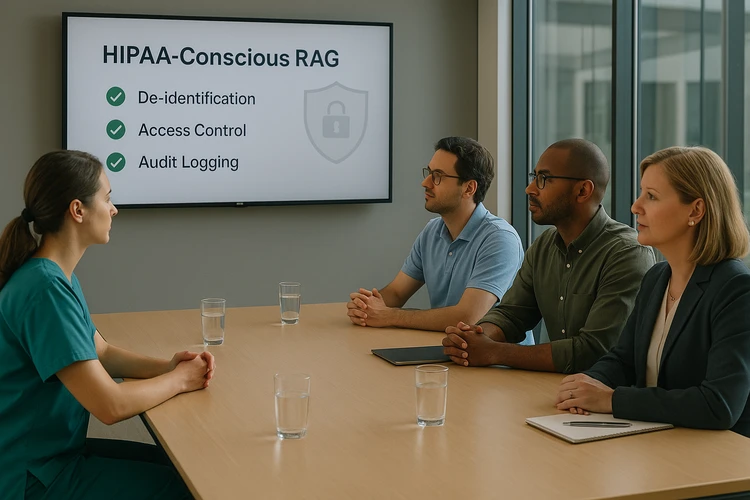
A HIPAA‑conscious design is fundamentally about defense in depth.
No single control should be your only barrier.
Core measures include:
- Least‑privilege access for all services and human users.
- Patient‑scoped retrieval and authorisation checks at the RAG API layer.
For secondary uses like research or model training, de‑identification becomes central.
- Safe Harbor and Expert Determination provide formal paths to treat data as non‑PHI.
- De‑identification pipelines should be reviewed by experts and periodically re‑validated.
Secure software practices also matter: threat modelling, code review, penetration testing, and robust incident response.
You can align with frameworks like the NIST AI Risk Management Framework to structure these efforts.
Bias, fairness, and documentation quality
Clinical notes reflect both care and clinician biases.
They can vary systematically by race, gender, socioeconomic status, and specialty.
A RAG system trained on such notes can amplify or obscure these disparities.
- Certain groups may be under‑documented or described with more negative language.
- Social determinants may be inconsistently captured, affecting downstream inferences.
Recent work on extracting social determinants of health (SDoH) with open LLMs shows both scalability and bias risks.
You should monitor how retrieval and summarisation perform across patient subgroups and clinical services.
Reliability, hallucination, and misuse
Even with RAG, LLMs can hallucinate.
They might confidently present findings not supported by the retrieved context.
Mitigations include:
- Instructions that force the model to base answers strictly on provided snippets.
- UI patterns that always show the source text next to the answer.
You should also define clear guidelines for appropriate use.
For example: “This tool supports documentation and chart review; it must not be used to generate medication orders.”
Governance and accountability
Good governance turns a clever demo into a sustainable system.
Practical steps:
- Maintain a model register describing which models you use, training data assumptions, and known limitations.
- Establish an interdisciplinary oversight group including clinicians, informaticians, legal, and security teams.
Logically, you also want traceability from clinical decisions back to supporting evidence.
RAG naturally helps with this because the source text is part of the workflow, not hidden.
Case Study: Longitudinal Heart Failure Summarisation
Clinical problem: complex handovers
Consider a patient with heart failure who has multiple admissions over several years.
They see cardiology, nephrology, and primary care, and medications change frequently.
Clinicians doing handovers or planning discharge need a concise, accurate view of:
The trajectory of heart failure and comorbidities. Key medication changes and reasons. Social context affecting adherence and follow‑up.
Data sources and typical issues
Relevant notes include progress notes, consults, clinic letters, and discharge summaries.
Each note may contain overlapping or outdated problem lists.
Common problems:
- Copy‑pasted text leading to redundancy and outdated statements.
- PHI sprinkled throughout, including names, phone numbers, and addresses.
- Important signals (e.g., missed follow‑up, transport issues) are buried in the narrative.
A tailored RAG workflow
A heart failure–focused RAG system might work like this:
-
Ingestion
Gather all notes for the patient over a multi‑year window.
Tag each note by speciality, setting (inpatient/outpatient), and major diagnosis codes. -
Chunking and indexing
Chunk notes into moderate‑sized passages that preserve local context (e.g., a problem‑oriented section).
Embed with a local, clinically tuned encoder and store embeddings in a patient‑aware index. -
Pre‑defined queries
Offer clinicians standard prompts like “Summarise the course of heart failure for this patient” or “List key medication changes and reasons.”
These can be templated queries to keep behaviour consistent. -
RAG inference
For each query, retrieve top‑K chunks with patient‑scoped filtering.
Ask the local LLM to produce a structured summary with sections for diagnosis, treatment, complications, and social context. -
Review and iteration
Display the summary with linked note snippets.
Allow clinicians to edit, reject, or accept the summary and log feedback.
Clinical decisions this can support
Such a system can speed up:
- Handover preparation during shift changes in cardiology units.
- Multidisciplinary meetings where several services need a shared understanding of the patient.
It can also help produce patient‑facing summaries (after clinician review), supporting education and adherence.
All of this happens while PHI stays inside controlled infrastructure, and retrieval is locked to a single patient.
Skills Mapping and Learning Path
Technical skills you build
Working on this kind of project develops a strong mix of skills:
- Python engineering: data models, pipelines, and APIs.
- NLP and embeddings: sentence transformers, cosine similarity, and RAG design.
It also pushes you into systems thinking:
- Designing services that talk to each other safely.
- Understanding GPU/CPU trade‑offs and cost implications.
Domain skills you gain
On the healthcare side, you’ll learn:
- What PHI is and why it’s regulated.
- How clinical notes are structured and how clinicians actually use them.
You’ll also become more fluent in HIPAA de‑identification patterns.
- The difference between Safe Harbor and Expert Determination.
- How de‑identification fits into the lifecycle of model development.
These domain skills are essential if you want to work on real clinical AI systems.
Suggested learning progression
A practical learning path might look like this:
-
Start with basic NLP
Build a sentiment classifier or news categoriser in Python.
Focus on text preprocessing, tokenisation, and embeddings. -
Move to vector search
Usesentence-transformers+ FAISS to build a semantic search over public, de-identified health text. Explore different similarity measures and chunk sizes and see how they affect retrieval. -
Prototype a small RAG system
Implement the core pipeline from this article using synthetic clinical notes. Experiment with prompts, context window sizes, and different top-K values for retrieval. -
Deploy a local LLM
Run an open-weight model using a framework likevllmorollama. Connect your RAG pipeline to it and measure latency, throughput, and answer quality. -
Layer on privacy and governance
Draw an architecture diagram showing PHI boundaries, roles, and access control. Write a short design doc explaining how your system supports HIPAA-conscious operation and auditability. -
Explore advanced topics
Add entity-aware retrieval for meds, labs, or diagnoses, and compare it with plain embeddings. Evaluate fairness and bias across synthetic patient cohorts and document your findings.
If you’d like structured support while building a project like this, our Data Science & AI Bootcamp walks you from Python and ML foundations to deployment-ready projects.
You can also compare all our online coding bootcamps and choose the path that best fits your next career move.
Conclusion
Key points to remember:
RAG is a natural fit for clinical notes because it grounds LLM outputs in real chart data.
A HIPAA-conscious design is about controlling PHI flow, enforcing boundaries, and limiting where sensitive data can travel.
Open-source, locally hosted LLMs and embedding models make it realistic to avoid sending raw PHI to external services. However, safe deployment still needs governance, monitoring, and interdisciplinary oversight from clinical, security, and data teams.
From a learning perspective, building a system like this touches Python, ML, MLOps, and healthcare ethics in one project. It’s a powerful way to prepare for real-world work in clinical AI, whether in a bootcamp setting or on your own.
If you’re ready to turn this into a portfolio-ready capstone, explore our Data Science & AI Bootcamp and related career-change programs at Code Labs Academy.
You’ll get live mentorship, structured projects, and the support you need to ship HIPAA-conscious AI systems with confidence.